
Broad Match vs Phrase Match for High-Intent PPC Campaigns
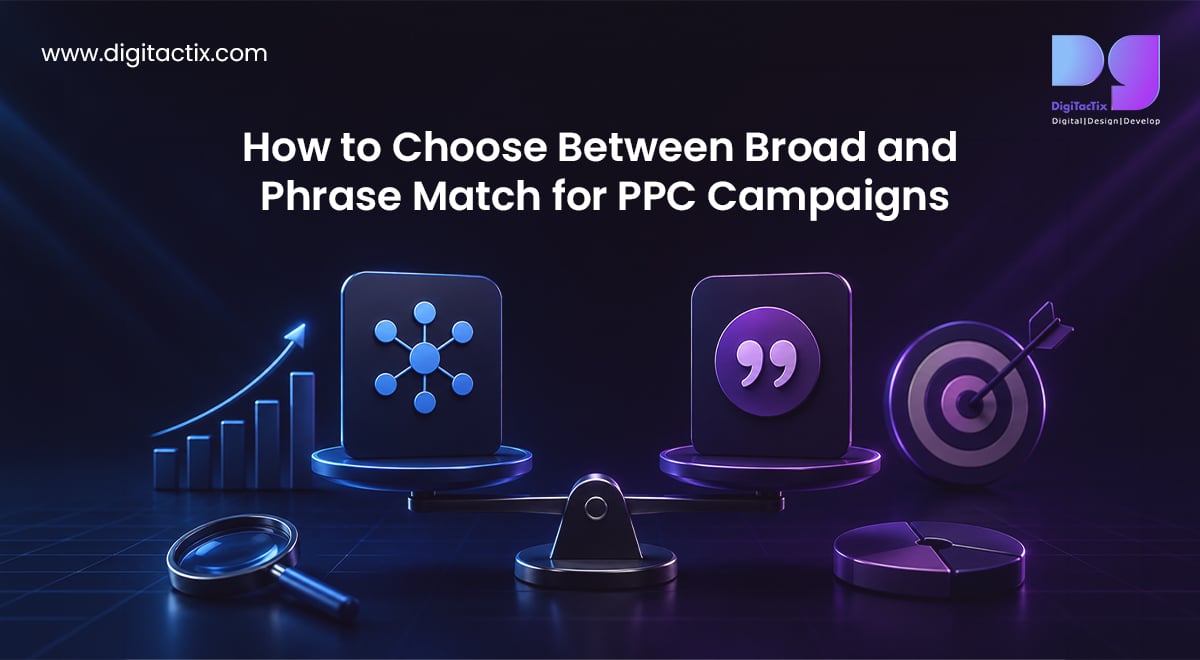
A campaign for searching could appear to be in good standing on the surface since it has strong impressions, steady clicks, and a decent amount of traffic, and yet still end up wasting its budget on the wrong searches.
It is there that the different types of keyword matching are important.
The problem that marketers face when carrying out PPC campaigns does not consist merely in deciding between broad and phrase matching; it is about determining how much control they need, how much reach they can afford, and how confident Google can be in identifying valuable search intent from the data on their account.
Broad match has the advantage of bringing in more traffic, while phrase match provides more precise control. However, in the case of High-intent PPC campaigns, one of these two options is not automatically the better choice. The appropriate option will vary according to your conversion data, bidding strategy, search-term quality, and the stage of maturity of the campaign.
Here is how to decide.
How Google Ads Match Types Work Today
Google at the moment provides three main Google Ads match types: broad, phrase, and exact. With broad match, you can reach all searches available to the more specific match types, plus some related queries; phrase match covers searches that match the meaning of your keyword, and exact match stays closest to the same meaning or intent.
That is an important shift from older keyword logic.
Matches between types now rely on more than just checking if specific words occur in the same order; Google increasingly takes into account meaning, context, and intent.
This means PPC keyword targeting is less about building enormous keyword lists and more about intelligently combining match types, conversion signals, bidding, negatives, and landing-page relevance.
Broad Match Keywords: More Reach, More Dependence on Signals
Broad match keywords give Google the widest freedom to find related searches.
Google can use signals including the content of the page a user lands on, other keywords in the ad group, and the user’s most recent search activity to better understand the user’s intent. It is also suggested that broad match be combined with Smart Bidding since the extra volume of queries provides the system with more data on which to base its optimisation for conversion goals.
That can work extremely well when a campaign already has:
- Reliable conversion tracking
- Enough conversion volume
- Strong landing-page relevance
- Clear negative keyword lists
- Conversion-based Smart Bidding
In that environment, broad match can help PPC campaigns discover valuable queries you may never have added manually.
The drawback is that weak signals lead to weak expansion.
Broad match will then scale up the exact wrong behaviour if the conversion tracking is incomplete or if poor-quality leads are treated as successes.
Phrase Match Keywords: More Control Over High Intent
Phrase match keywords sit between exact and broad.
Google states that phrase match can apply to searches which include the meaning of your keyword, such as more specific expressions of that meaning. It covers fewer searches than broad match but does provide greater control over the type of query that will trigger an ad.
For High-intent PPC campaigns, that tighter scope can be useful.
Picture a business that is aimed at “enterprise cybersecurity services”—phrase matching can assist in keeping the campaign aligned with searches for that service and in reducing the amount of unrelated discovery.
That makes phrase match particularly helpful when:
- Budget is limited
- Search volume is manageable
- Lead quality matters more than maximum scale.
- The offering is highly specific.
- Regulatory or industry restrictions require closer targeting.
Google itself notes that phrase or exact match may still be useful where advertisers need tighter control over the searches they appear against.
Which Match Type Is Better for PPC Campaigns?
For most advertisers, the answer is not “pick one forever.”
A better approach is to use match type according to campaign maturity.
Because phrase match can provide marketers with more insight into the searches that are actually leading to conversions, early-stage PPC campaigns may find it advantageous. The data obtained in this way can be used to create negative keyword lists, to identify high-value search themes, and to improve the landing pages.
When the account has more conversion data, broad match can then be more useful since Smart Bidding will have more information to work with.
This is especially relevant for PPC campaign management where marketers are constantly balancing scale against efficiency.
Think of phrase match as controlled expansion. Broad match is wider exploration, but with more reliance on algorithmic decision-making.
Broad Match vs Phrase Match for High-Intent PPC Campaigns
For High-intent PPC campaigns, start with the quality of intent rather than the size of the audience.
If you know precisely what your best prospects are searching for, phrase match keywords can give you a more controlled starting point.
If you already have strong conversion history and want to uncover incremental opportunities, Broad match keywords can help expand reach beyond obvious search terms.
The best method might be to combine different elements.
Perform a phrase match for highly valuable commercial terms; test broad match in campaigns that have strong conversion data and are using Smart Bidding; and then assess their performance according to qualified leads, revenue, or downstream business value, not just clicks.
That distinction matters.
A keyword that produces 50 conversions is not valuable if none of them become customers.
Negative Keywords Still Matter
Broader targeting does not mean giving up control.
It is still important to use negative keywords to eliminate irrelevant traffic, since they can stop ads from appearing for searches that may be semantically related but commercially meaningless.
This is particularly important in the case of broad match.
Strong PPC keyword targeting should therefore include regular search-term reviews, negative keyword updates, and lead-quality feedback from sales or CRM systems.
You shouldn’t focus solely on optimization within Google Ads; instead, link media performance to actual business outcomes.
Use Match Types as Part of Better PPC Campaign Management
Match types work best when they are treated as one part of the campaign system.
Good PPC campaign management should connect:
- Match type
- Smart Bidding
- Conversion tracking
- Search-term analysis
- Negative keywords
- Ad messaging
- Landing-page intent
- Lead-quality data
When the various components work in unison, broad and phrase matching become tools rather than rules.
The question is not “Which match type gets more traffic?”
It is “Which match type gives us the right level of control while helping us reach more customers likely to convert?”
How Digitactix Builds Smarter PPC Campaigns
At Digitactix, we approach PPC campaigns around business outcomes rather than keyword volume alone.
We evaluate Google Ads match types, search intent, conversion quality, bidding signals, and landing-page performance together to determine where tighter control is needed and where broader targeting can create incremental growth.
Our approach to PPC campaign management also includes continuous search-term analysis and PPC keyword targeting so campaigns can evolve as real performance data comes in.
Broad match and phrase match both have a place.
The difference comes down to knowing when to use each, and having enough clean data to make that decision with confidence.
In PPC campaigns, broad match can show ads for a wider range of related searches, while phrase match keeps targeting closer to the meaning of the selected keyword. Broad match offers more reach and discovery, whereas phrase match gives advertisers greater control over search relevance and can be useful when targeting more specific user intent.
There is no single best match type for all PPC campaigns. Phrase match may suit campaigns that need tighter control and stronger relevance, while broad match can work well when there is reliable conversion data and Smart Bidding. The right choice depends on campaign goals, budget, search volume, and the quality of conversion tracking.
Broad match keywords can be useful in PPC campaigns when you want to expand reach, discover new search queries, and have enough conversion data to guide automated bidding. They often work best with strong conversion tracking, relevant landing pages, Smart Bidding, and a well-maintained negative keyword list to reduce unnecessary or low-value traffic.
Phrase match keywords are useful in PPC campaigns when you want to stay closer to specific search intent without limiting reach as much as exact match. They can be especially helpful for niche services, limited budgets, high-value keywords, or campaigns where lead quality and control over search relevance are more important than maximum traffic volume.
Keyword match types influence how widely PPC campaigns can reach users and how closely searches align with selected keywords. Broader targeting may increase impressions and uncover new opportunities, while tighter targeting can improve control and relevance. Performance ultimately depends on search intent, bidding strategy, conversion tracking, negative keywords, landing pages, and ongoing optimization.